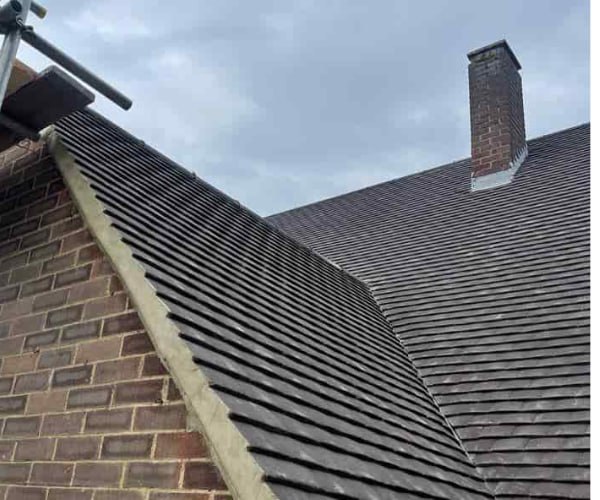
Why Temporary Roof Repairs Must Be Followed by a Lasting Solution
When a roof develops a sudden leak or becomes damaged, a temporary repair can be extremely useful. It may help limit immediate water ingress, protect the affected area and provide short-term stability until the roof can be properly assessed and repaired. However, temporary work is intended to manage an immediate problem rather than provide the final solution.
For property owners in Hatfield, South Yorkshire, understanding the difference between temporary and lasting roof repairs is important. Once the immediate situation has been controlled, attention should turn to identifying why the roof failed, how far the deterioration extends and what work is needed to restore the affected section properly. Without this follow-up, the same weakness may remain beneath or around the temporary repair and eventually cause the problem to return.
Why Should a Temporary Roof Repair Be Followed by Permanent Work?
A temporary roof repair is usually designed to reduce immediate exposure rather than reconstruct the damaged part of the roofing system completely. This can be appropriate when conditions prevent full repairs from being carried out straight away or when further investigation is required before the correct work can be planned.
The important point is that temporary protection should form part of a wider repair process. Once circumstances allow, the underlying defect needs to be identified and addressed so that the roof can return to dependable service.
Temporary Repairs Serve an Important Purpose
Temporary roofing work should not be viewed as ineffective simply because it is not intended to remain indefinitely.
When damage occurs unexpectedly, immediate protection can help prevent the affected area from remaining fully exposed. This can be particularly valuable where tiles have moved, part of the covering has become vulnerable or water is entering the property.
The temporary measure creates an opportunity for the roof to be assessed more thoroughly.
Its purpose is to control the situation until an appropriate lasting repair can be completed.
Stopping the Immediate Leak Does Not Always Remove the Cause
When water stops entering after temporary work, it can be tempting to assume that the problem has been resolved.
However, stopping visible water ingress and repairing the underlying defect are not necessarily the same thing.
The temporary measure may simply be preventing rain from reaching an existing weakness. Damaged roofing materials, deteriorated flashing, unstable tiles or another defect could still remain beneath or alongside the temporary protection.
Once that protection deteriorates or moves, the original problem may become exposed again.
Roof Leaks Can Be More Complicated Than They Appear
The location where water becomes visible indoors does not always correspond directly with the external roof defect.
Water can enter through one point and travel along underlay, timbers or other surfaces before appearing elsewhere. This means an emergency response may understandably concentrate on controlling the immediate water ingress rather than completing a full diagnosis at that moment.
Follow-up assessment allows the roof to be investigated systematically.
Finding the actual entry point is essential if the permanent repair is going to address the cause rather than simply the internal symptom.
The Underlying Roof Damage May Extend Beyond the Visible Area
A visible defect does not always reveal the complete extent of deterioration.
One slipped tile may be obvious while neighbouring tiles or fixings have also become unstable. A damaged section of flashing may form part of a larger area requiring attention. Similarly, a leak may expose deterioration beneath the outer roof covering that cannot be assessed from the ground.
A lasting repair should therefore be based on the complete affected area.
This helps avoid repairing only the most obvious component while leaving connected weaknesses unresolved.
Temporary Materials Are Not Intended to Replace the Roofing System
Temporary protection is selected for a different purpose from permanent roofing materials.
It may be used to cover an exposed area, restrict water entry or provide short-term protection while the proper repair is arranged. It is not normally intended to reproduce every function of the original roof construction indefinitely.
A roof is made up of connected components designed to manage rainfall and protect the structure beneath.
Restoring those components appropriately is what provides the lasting solution.
Weather Can Test a Temporary Repair Repeatedly
Roofs are continually exposed to changing conditions.
Rainfall and wind can place repeated demands on temporary protection, particularly where the original roof covering remains damaged underneath. A measure that successfully prevents water ingress during one period of weather may become less effective after continued exposure.
This is why a temporary repair should not be forgotten simply because the roof remains dry initially.
Its performance over a short period does not mean that the underlying defect has disappeared.
Wind Can Affect Already Vulnerable Roofing Materials
Where roof damage involves loose or displaced components, further windy conditions can increase movement.
A temporary measure may reduce immediate exposure, but surrounding materials still need to be checked for stability. If neighbouring tiles, ridge components or other sections have also become loose, deterioration can continue beyond the originally affected area.
Permanent repair provides an opportunity to secure or replace the appropriate components.
This helps restore the affected section as part of the complete roof rather than relying on temporary protection over unstable materials.
Water Can Continue Finding Vulnerable Routes
Water can exploit relatively small openings within a roofing system.
If the original defect has not been permanently corrected, rainfall may eventually find another route around temporary protection. The resulting internal damp patch may even appear in a slightly different position from the original leak.
This can make the problem seem like a new defect when it may be connected to the same unresolved weakness.
Following temporary work with proper diagnosis reduces the likelihood of repeatedly chasing visible symptoms.
A Dry Ceiling Does Not Prove That Everything Beneath the Roof Is Dry
Once visible dripping stops, it is easy to focus solely on the condition of the ceiling.
However, moisture may previously have entered parts of the roof construction before becoming noticeable indoors. The absence of further dripping does not by itself establish the condition of materials around the original leak.
A follow-up inspection can assess the relevant roof area and determine what work is required.
This provides a clearer understanding of the problem than relying exclusively on whether an internal stain appears to be getting larger.
Temporary Repairs Can Help With Accurate Planning
One advantage of temporary work is that it can create time for a more considered approach.
Instead of making assumptions during an urgent situation, the roof can subsequently be assessed to establish what has failed and how the surrounding materials have been affected.
The permanent repair can then be planned around the actual defect.
This is preferable to carrying out unnecessary work across sound roofing areas or, conversely, completing too small a repair where deterioration extends further than first thought.
Previous Roof Repairs Should Be Considered
Where a roof has a history of repairs, this information can help when planning a lasting solution.
A leak close to a previously repaired section may indicate deterioration in adjoining materials rather than failure of exactly the same component. Alternatively, repeated problems within one area may suggest that the original source has not yet been fully identified.
The repair history should therefore form part of the assessment.
Understanding what has happened previously can help identify patterns that are not apparent from the latest leak alone.
Repeated Temporary Repairs Can Hide a Developing Pattern
Using temporary measures repeatedly in the same area can make it increasingly difficult to understand the true condition of the roof.
One small repair may be followed by another nearby as individual symptoms appear. Over time, the roof can develop several patched sections without the underlying pattern being properly investigated.
If problems continue returning, broader assessment becomes important.
The issue may still be localised, but repeated failures can indicate that a larger connected section requires attention.
Recurring Leaks Deserve Further Investigation
A leak that disappears temporarily and then returns should not simply be treated as an unavoidable inconvenience.
Recurring water ingress can indicate that the original entry point remains active or that deterioration has progressed to adjoining materials.
The circumstances in which the leak returns can also provide useful clues.
For example, water appearing only during particular weather conditions may help identify which roof detail is vulnerable. This information can assist with planning a more targeted permanent repair.
Permanent Repairs Should Address the Cause
The central difference between temporary protection and a lasting repair is the focus on the underlying cause.
If a tile has slipped, it is useful to understand whether the issue is confined to that tile or whether nearby components also need attention. If flashing has deteriorated, the complete affected junction should be considered.
The objective is not simply to cover the place where water seems to be entering.
It is to restore the relevant roofing detail so that it can perform its intended function again.
Localised Permanent Repairs Can Often Be Appropriate
Following a temporary repair does not automatically mean extensive roofing work will be necessary.
If the problem is genuinely localised and the surrounding roof remains in satisfactory condition, a focused permanent repair may be appropriate.
This is an important distinction.
Professional assessment should identify the work that is actually required rather than assuming that one leak means a large section of roof must be replaced.
Several Connected Defects May Require a Wider Repair
In other situations, the inspection may reveal that the original problem is part of a larger area of deterioration.
Several tiles may have moved, surrounding materials may have weakened or a roof junction may be deteriorating across a broader section.
Completing a very small permanent repair in the middle of unstable materials can leave the neighbouring weaknesses unchanged.
Where deterioration is connected, extending the repair until sound roofing components are reached can provide a more appropriate solution.
Flashing Problems Need Proper Attention
Flashing protects some of the more vulnerable junctions within a roof.
Where it becomes displaced or deteriorated, temporary covering may help restrict immediate water ingress. However, the affected detail still needs to be restored appropriately.
Simply leaving temporary protection over defective flashing does not address why water was able to enter.
A lasting repair should consider the complete junction and its relationship with the surrounding roof covering.
Slipped and Missing Tiles Should Be Assessed in Context
A slipped or missing tile can create an obvious vulnerability, but it is useful to understand why it moved.
The problem may be isolated, particularly where surrounding materials remain secure. Alternatively, several nearby tiles or fixings may also have deteriorated.
Replacing the obvious tile can be entirely appropriate when the problem is contained.
Where movement extends further, the surrounding section should also be addressed so that another defect does not appear shortly afterwards.
Roof Valleys Can Require More Than Temporary Protection
Valleys manage water from adjoining roof slopes and are therefore important parts of the roof drainage arrangement.
Where deterioration occurs within a valley, temporary measures may restrict immediate ingress, but the underlying detail should still be investigated.
Debris, movement or deterioration can affect how effectively water passes through the area.
A lasting solution needs to restore the valley so that rainfall can continue to move through the roof as intended.
Ridge Areas Should Not Be Overlooked
Problems near the ridge can sometimes allow water to enter relatively high on the roof.
Once inside, that moisture may travel before becoming visible lower down. This can make the source difficult to identify during an urgent response.
Follow-up inspection allows the ridge and surrounding roof covering to be considered alongside the internal evidence.
Where deterioration is found, the appropriate permanent work can then address the actual entry point.
Delaying Permanent Work Can Allow Deterioration to Spread
A temporary repair may be successfully controlling the immediate problem, but damaged materials underneath can remain vulnerable.
If the permanent repair is continually postponed, further movement or deterioration may affect surrounding components.
A defect that initially required relatively contained work can consequently become more involved.
Following up at an appropriate stage helps preserve roofing materials that remain sound and reduces the opportunity for the affected area to expand.
Internal Staining Can Continue Changing After the Leak Is Controlled
A ceiling stain may remain visible even after water ingress has stopped.
This can sometimes create confusion about whether the temporary repair is working. Conversely, a stain that appears unchanged can give false reassurance that the underlying roof problem no longer requires attention.
Internal appearance should therefore not be the only measure used to judge the roof.
The external defect still needs to be assessed and repaired appropriately.
Signs That a Temporary Roof Repair Needs Follow-Up
Professional follow-up is particularly important where:
- the original repair was specifically intended as a temporary measure;
- tiles or other roofing components remain damaged beneath the protection;
- the leak has occurred more than once;
- dampness returns during rainfall;
- several nearby roofing components appear unstable;
- the source of the original leak was uncertain;
- water ingress occurred around flashing or a roof junction;
- the affected area has a history of previous repairs;
- further deterioration is visible around the temporary work.
The absence of an immediate leak should not be taken as confirmation that permanent work is unnecessary.
A Lasting Solution Begins With Proper Assessment
Before permanent work is carried out, the affected roof section should be inspected to establish what actually requires repair.
This can include considering the outer roof covering, junctions, flashing and the condition of neighbouring components. Internal evidence may also help establish how water travelled through the roof.
The findings can then guide the scope of the repair.
This condition-led approach helps ensure that sound roofing materials are retained where practical while genuine defects receive the attention they require.
Why Professional Roof Repairs Make a Difference
Professional roofing work provides more than a replacement for temporary covering.
The value lies in identifying the defect, understanding its extent and restoring the affected roofing components appropriately.
This is particularly important when a leak has returned or the original cause was difficult to locate.
Rather than repeatedly responding to the same internal symptom, professional assessment can focus the repair on the route through which water is entering the roof.
Professional Roof Repairs in Hatfield, South Yorkshire
At SM Roofing Hatfield, we understand that temporary roof repairs can provide valuable immediate protection but should be followed by an appropriate lasting solution.
A proper assessment can establish whether the original problem is confined to a small section or whether surrounding tiles, flashing or other roofing components also require attention.
For property owners in Hatfield, South Yorkshire, addressing the underlying defect after temporary work can help restore the affected section of roof and reduce the likelihood of the same problem returning.
Conclusion
Temporary roof repairs play an important role when immediate protection is needed. They can help control water ingress and protect a vulnerable area until the roof can be assessed and suitable permanent work carried out.
However, temporary protection does not necessarily correct the defect underneath. Damaged tiles, deteriorated flashing, vulnerable junctions or other weaknesses can remain and may eventually allow water to enter again. Repeated temporary repairs can also mask a developing pattern if the underlying cause is never properly investigated.
A lasting solution should therefore begin with identifying why the roof failed and determining how far the problem extends. Where deterioration is localised, a focused repair may be sufficient. Where connected materials have also weakened, a broader repair can address the complete affected area.
If your property in Hatfield, South Yorkshire has received a temporary roof repair or you are dealing with a recurring leak, contact SM Roofing Hatfield. We can assess the affected roof area, identify the likely cause and recommend an appropriate lasting repair based on its actual condition.
Call us on: 01302 430 895
Click here to find out more about SM Roofing Hatfield
Click here to complete our contact form and see how we can help with your roofing needs.